

Equity Perspectives - Fourth Issue 2026
Latest market updates from the United States, Europe/UK, and HK/China


Market Snapshot
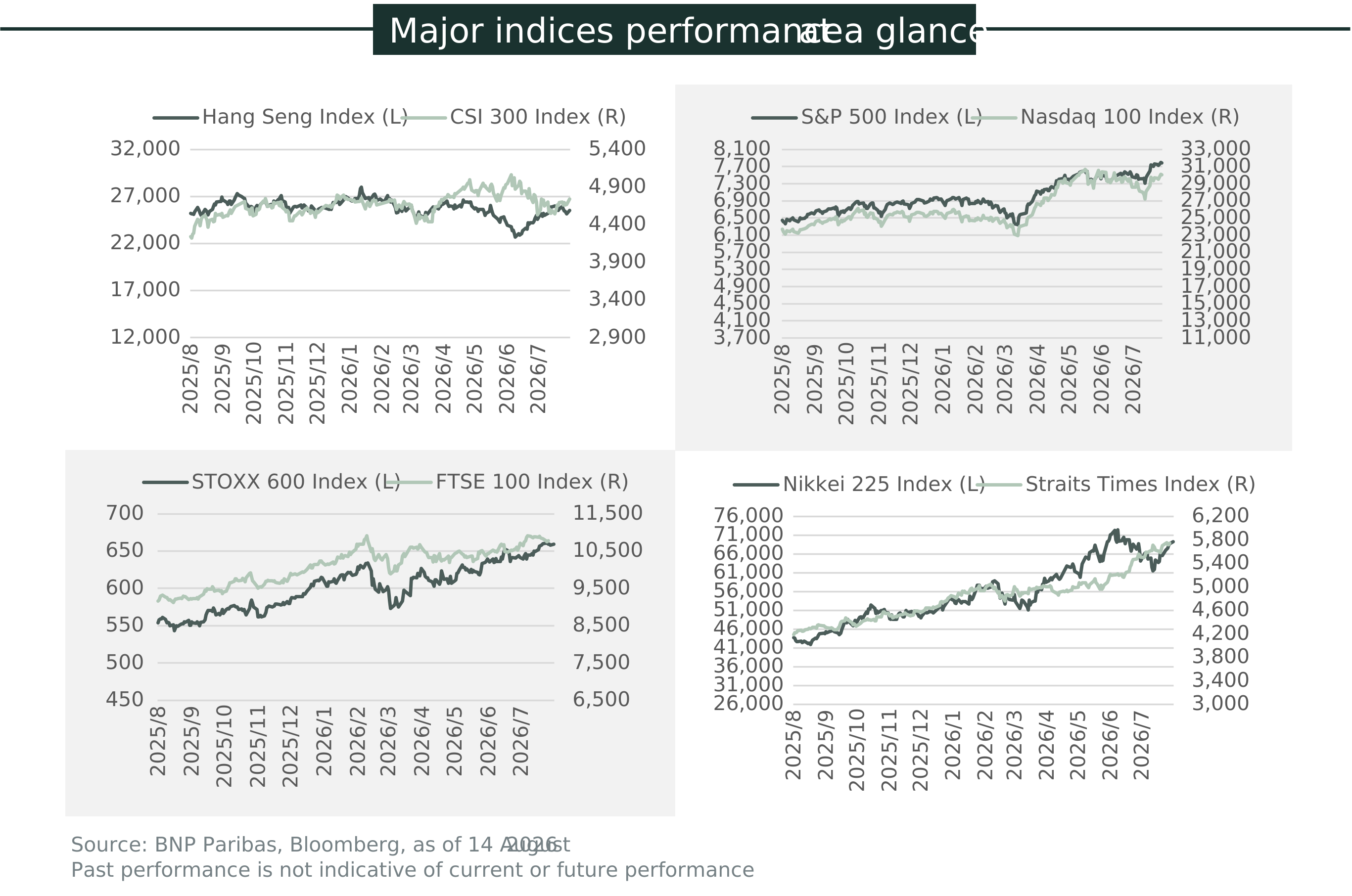
- Since our June 2026 update, global equities experienced a significant bout of volatility, driven by a sell-off in chipmakers amid stretched investor positioning and excessive leverage, highlighting our prior recommendation to exercise prudence.
- Nevertheless, US indices remained largely resilient amid the volatility as stellar second quarter (Q2) 2026 earnings underpinned non-chipmaker performance and led to a broadening out in the country’s equities.
- European shares reached record highs amid relatively cooler tensions in the Middle East and solid Q2 2026 results, while Hong Kong stocks recovered as investors flocked back to relatively beaten-down internet and healthcare names.
- We remain constructive on AI beneficiaries amid elevated hyperscaler capex plans and supply/demand dynamics. Risk-reward profile is also more favourable following the recent de-risking in investor positioning

📑HK / China Updates

📑US Updates

📑Europe/UK Updates


No rush for new stimulus
What happened?
The unwinding of leveraged pair trades of short-Hong Kong long-Korea in July 2026 breathed life into the unloved China internet and healthcare names. Hang Seng Index rebounded as much as 15% from the 52-week low on 26 June 2026. It is noteworthy that two leveraged single-Korean stock ETFs listed in Hong Kong together accounted for nearly 10% of total Hong Kong stock market turnover in late-June 2026, but their combined contributions have fallen to around 3% since early August 2026.
On the other hand, onshore A-share markets consolidated in recent weeks after reaching multi-year highs in the second quarter of 2026. We notice three interesting developments: (1) primary market financing expanded further on major IPO debuts; (2) secondary market turnover fell from recent highs despite corporate share buyback amount grew 33% in July 2026 to a 29-month high; (3) onshore ETFs saw strong net inflows led by “the national team”. However, we reckon the gradual uptrend of A-share markets remain intact, underpinned by domestic fund reallocation and potential policy tailwinds.
Our thoughts
- China semiconductor stocks are not immune to the global correction of AI trades. We believe the shakeouts have created buying opportunities of selected high-quality technology leaders, who indeed published consensus beating results for June 2026-quarter and outlook for the coming quarters.
- Large state-owned banks have outperformed insurers year-to-date. We now see good chance of reversal of relative performance in the rest of 2026. For banks, both loan growth and net interest margin improvement showed signs of slowdown amid subdued real economy credit demand. On the other hand, insurers are expected to enjoy improving net investment yields, robust demand for wealth management products and capital market reforms.
- The 2026 US midterm elections introduce distinct policy risks till November 2026 given that “China threat” has been repeatedly used by US politicians to draw voters’ attentions, worsened by the Trump administration’s flip-flopping policies on China issues.
How to play the game?
🎯Areas on our radar: Details of new policies in accordance with China’s 15th Five-Year Plan, anti-involution policies, China AI development.
🔎Investment implications: Emerging industries highlighted in China’s 15th Five-Year are expected to meet new favourable policies. Selected consumer brands which have pricing power.
Notable Developments in Selected Sectors
- China Banks: Both loan growth and net interest margin improvement showed signs of slowdown amid subdued real economy credit demand. Aggregated origination of total social financing fell by RMB1.7 trillion year-on-year (YoY) to RMB22.3 trillion in the first seven months of 2026. While many banks enhanced net interest margin in the first half of 2026 through deposit repricing, we see limited room for further deposit cost reduction.
- Property: After Shanghai and Shenzhen, Beijing also eased housing policies on 7 August 2026. As Beijing is historically one of the most restrictive housing markets, we believe this new round of easing sends a significant signal.
- Healthcare: Biotech and biomedicine finally gained momentum in recent weeks. Latest sector tailwinds include: (i) a China biotech firm won injunction against the US Section 1260H that reduced policy uncertainty for the sector; (ii) more business development deals between Chinese and international pharmaceutical firms are expected to be announced during the World Conference on Lung Cancer (WCLC) in September 2026 and European Society for Medical Oncology (ESMO) in October 2026.

Stronger than expected Q2 reporting season. Look for further broadening in 2H.
What happened?
US equities added further gains over the past two months on the back of a stellar set of Q2 reporting season, which saw a sharper than expected rate of estimate beats and underscored our prior highlight of tactical opportunities following March 2026’s sell-off.
Our thoughts
- Exceptional Q2 reporting season, with proportion of stocks beating estimates up materially (~88% of reporting firms beat expectations, well above the ~76% historical beat rate). S&P 500 index’s Q2 earnings growth is estimated at ~31% year-on-year excluding income related to some private investment stakes. AI infrastructure stocks which have benefitted from higher capex spending have driven roughly half of the Q2 earnings per share (EPS) growth, although earnings growth for the rest of the market has also shown positive signs of acceleration, with potential broadening trends expected in second half (2H) 2026.
- In their latest results release, US hyperscalers have affirmed continued hike in AI capex plans, which has further supported AI infrastructure stock returns, although longer term clarity is still awaited on the AI monetisation story, while recent Kimi K3 launch from China has also increased investor scrutiny on US firms to find greater efficiencies and advancements in algorithms.
- On key calls, we still favour investing in multiple sectors beyond tech which also benefit from elevated hyperscaler capex investment plans (such as industrials, utilities and materials) and continue to see positive medium-term risk-reward in key bottleneck areas of semiconductors, memory and power infrastructure/ electrification, where demand/supply dynamics are expected to remain imbalanced going into 2027. For semiconductors, our thesis is maintained for continued strong earnings growth momentum, with still favourable memory pricing dynamics amid elevated AI capex plans. Following recent de-risking in investor positioning, we see tactical entry opportunities opening up although investors will need to be able to tolerate the higher volatility expected for the sector.
- We remain selective stance with broad valuations now trading at the higher end, reflecting more robust earnings growth expectations. The S&P 500 index last trades at 19.2x forward price/earnings ratio (as of 16 August 2026), about +1 standard deviation above its past 5Y historical average multiple of 17.9x. 2026E & 2027E consensus forecasts for MSCI US earnings growth has been upgraded to 28.5% & 16.7% respectively, higher vs World’s 24.7% & 14.6% earnings growth expected.
How to play the game?
🎯Areas on our radar: Hyperscaler capex plans, economic growth trajectory, Fed rate decisions
🔎Investment implications: Maintain prudence and diversification, favouring quality firms with healthy balance sheets.
Notable Developments in Selected Sectors
- Information Technology – The AI trade has regained momentum following earlier sell-off, with recovery in key memory leaders reinforcing confidence in the broader buildout. Hyperscalers also used the latest earnings event to push AI infrastructure capex higher, supporting demand visibility. We remain focused on capturing the secular AI trend through a diversified approach centered on high-quality market leaders.
- Financials - Financial services firms are looking to build growth opportunities around the AI boom. Asset managers recently partnered with Nvidia to create independent “compute financing platforms”. These firms will assemble large pools of third-party institutional capital and turn AI hardware and data centres into a standardised, investable asset class backed by institutional and private wealth. This initiative could unlock long-duration, usage-linked revenue streams tied to physical assets.
- Real Estate – US data centre REITs (DCREITs) have been among the top‑performing segments of US real estate year‑to‑date, driven by a surge in capacity demand from AI inference workloads. Inference‑driven demand creates a structural tailwind for large‑scale, distributed colocation networks, a niche where US DCREITs are well‑positioned as evidenced by their accelerating development pipelines and revenue growth.

Cautious optimism
What happened?
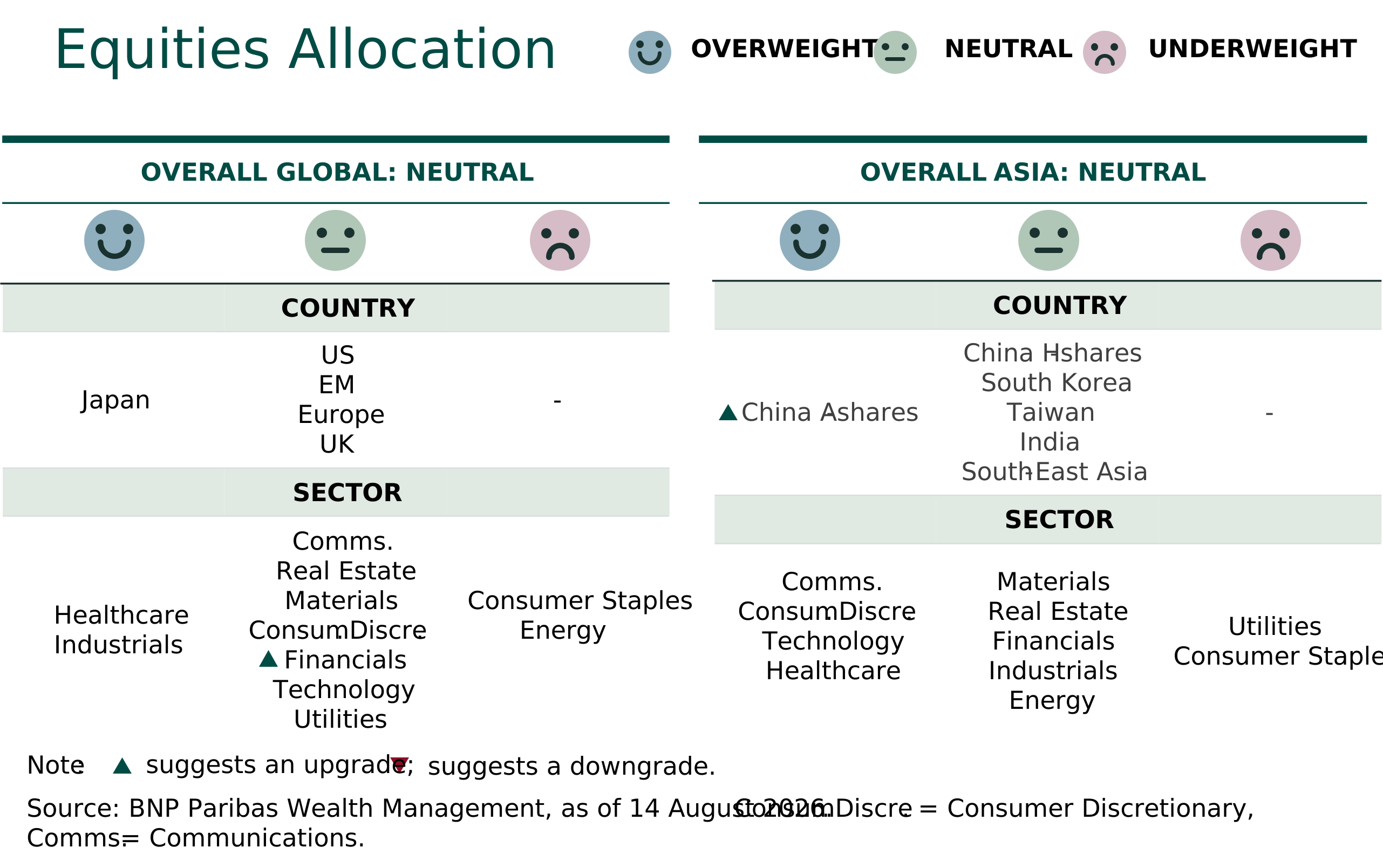
We have upgraded our view to Neutral from Underweight on Europe due to an easing of geopolitical tensions in the Middle East.
Our thoughts
- Despite persistent market uncertainty, the STOXX Europe 600 Index has demonstrated notable resilience in recent months, hitting fresh record highs in August 2026. This performance has been supported by undemanding valuations, particularly when compared to the relatively elevated US market. A potential agreement between the US and Iran is expected to boost risk appetite and reduce geopolitical tensions, supporting more economically-sensitive markets in Europe.
- We have also revised our sector allocations, upgrading European travel & leisure, automobiles, and media to Neutral, while European Banks have been upgraded to Overweight to reflect a potential rotation into more cyclical areas. Separately, because European benchmarks are less concentrated in mega-cap tech, they offer a more diversified investment approach. Performance has been assisted by a supportive earnings season. Even when excluding energy, corporate profit growth for European firms remains robust at ~12%.
- Q2 2026 results season has delivered EPS growth of ~24% YoY, ahead of consensus expectations and is on course for the strongest quarter in several years, with energy and financials accounting for most of the upside. This is despite a recent re-escalation of tensions in the Middle East. At the same time, wildfires in Europe could lead to higher insurance losses, transport and supply chain disruptions, and weaker consumer spending, which could yet be reflected in future quarterly results. 2025’s unprecedented fiscal spending plan in Germany that supports both infrastructure and defence spending, is still a key multi-year secular driver for a range of sectors, even if initial spending has been slower than anticipated.
- Separately, the FTSE 100 has regained momentum, although yet to retest February 2026’s record high. The UK has navigated a turbulent political backdrop – Prime Minister Keir Starmer resigned and former Manchester mayor Andy Burnham replaced him. Investors will likely await the Labour Party conference in September 2026 and the subsequent Autumn budget for clearer signals on fiscal and economic policy. As of 17 August 2026, the FTSE 100 was valued at 13.2x forward P/E. Our stance remains Neutral.
How to play the game?
🎯Areas on our radar: AI-adjacent names continue to benefit from global trends; front-end loaded fiscal and defence spending in 2026.
🔎 Investment implications: Semiconductors, infrastructure and defence spending to become key driver of opportunities, given the lower support from monetary policy.
Notable Developments in Selected Sectors
- Industrials: Industrials are emerging from a destocking cycle that has weighed since 2024. Manufacturing PMIs are stabilising in expansionary territory, with improving activity in data centres, automation, semiconductors and aerospace but lacking wider follow-through in consumer-facing areas like residential construction and autos.
- Financials: European Banks were upgrade to Overweight. The sector is again outperforming the Stoxx 600 year-to-date, having beaten the market for five consecutive years. Banks are among the market leaders in Q2 earnings beats, supported by a healthy operating environment, including strong trading. The potential for higher interest rates should support rate-sensitive Spanish and Italian banks.
- Consumer Discretionary: Travel & leisure and automobiles were upgraded to Neutral, reflecting sector rotation toward more cyclical areas on an improvement in geopolitical sentiment in the Middle East. The outlook for travel is expected to strengthen further should a durable peace agreement with Iran be reached. Several headwinds persist in the autos space, though much of the associated uncertainty appears to be already priced in. Valuations remain favourable, albeit this has become the prevailing norm.

Please read carefully the disclaimer here: https://wealthmanagement.bnpparibas/asia/en/disclaimer1.html